

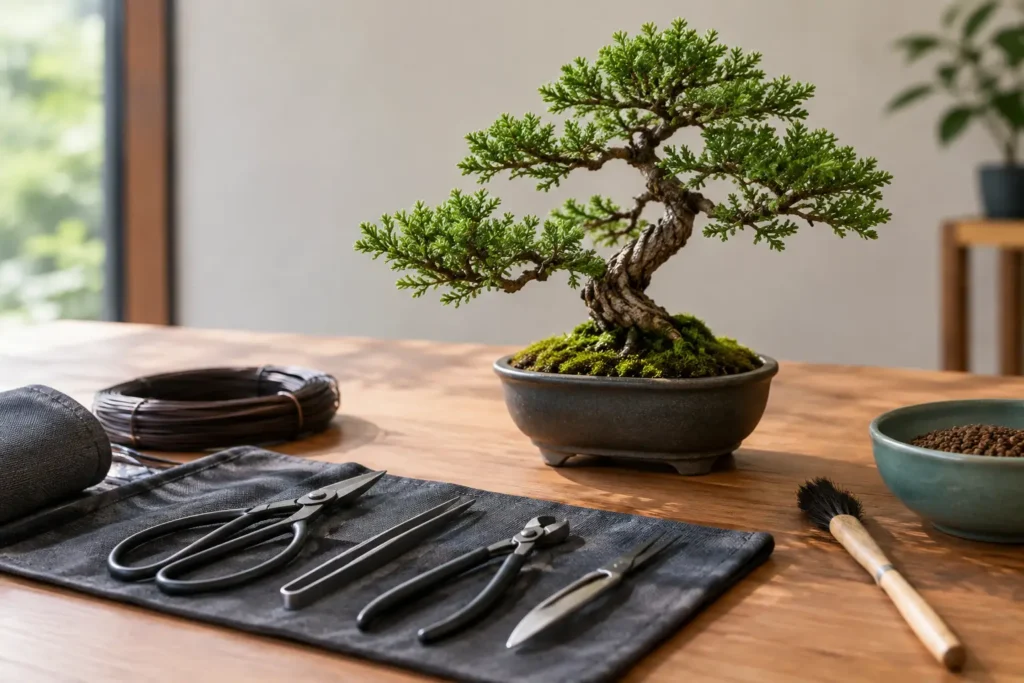
That tiny pair of scissors in a cheap bonsai kit can look very convincing beside a neat little tree. The trouble is, many beginner bonsai tools are bought before you know what job they need to do. A healthy first bonsai needs good light, sensible watering and the right potting mix far more urgently than it needs a full tray of shiny gear.
Buy a few useful tools first, then add specialist pieces as your tree and confidence grow. You will spend less, make cleaner cuts and avoid filling a drawer with tools that only make sense after your third repotting.
The beginner bonsai tools to buy first
For most beginners, five items cover almost every routine job: a pair of pruning shears, a pair of fine scissors, a concave cutter, a root rake or chopstick, and a watering can with a fine rose. You do not need to buy them all on day one, but this is a sensible shopping list to work towards.
1. Pruning shears for branches and thicker shoots
Pruning shears are the workhorse tool. Use them for woody twigs and small branches that are too firm for fine scissors. Look for a comfortable spring action, sharp blades that meet cleanly, and handles that suit your hand. A tool that feels awkward will lead to hesitant, ragged cuts.
For a first tree, a small to medium pair is usually more useful than oversized shears. Larger tools can feel powerful, but they are clumsy around a compact canopy. If you own a young ficus, Chinese elm or jade bonsai, decent pruning shears will get plenty of use.
Do not use ordinary household scissors for branches. They can crush living tissue rather than slicing it cleanly, especially when the branch is woody. Clean cuts heal better and look tidier while they do.
2. Fine scissors for leaves and soft growth
Fine bonsai scissors are for detail work: trimming soft shoots, removing tired leaves and tidying growth in crowded areas. Their narrow tips let you work between branches without knocking off buds you meant to keep.
They are particularly handy for ficus and Chinese elm bonsai, which can produce lots of small leafy growth in warm Australian conditions. For a jade or portulacaria, however, scissors may see less action because stems and leaves are fleshy and are often better pinched or cut with shears.
Choose stainless steel if you want lower-maintenance tools. Carbon steel is often sharper and lighter for the price, but it needs drying after use and a light wipe with camellia oil or another suitable tool oil to prevent rust.
3. A concave cutter for cleaner branch removal
A concave cutter is the first specialist tool worth owning. Its curved jaws remove a small amount of wood around the base of a branch, leaving a shallow wound rather than a blunt stump. As the tree heals, that shallow cut is more likely to blend into the trunk.
This does not mean you need to use one every weekend. Major branch decisions should be made slowly, because a branch removed in ten seconds may take years to replace. But when you do need to remove a branch cleanly, a concave cutter is far better than forcing pruning shears through wood they cannot handle.
Buy a modestly priced, well-made cutter rather than the cheapest one you can find. Check that the jaws close neatly with no visible gap. Avoid using it on wire, dry hardwood or branches larger than the maker recommends. That is a quick way to damage the cutting edge.
4. A root rake or humble chopstick
At repotting time, you need a way to loosen old mix and gently tease roots apart. A root rake does this neatly, especially on established trees with compact root balls. A bamboo chopstick also works remarkably well for a first repot, and plenty of experienced growers still use one.
The chopstick option is not a shortcut or a beginner mistake. It gives good control and is less likely to tear fine roots if you work patiently. Spend your money on proper bonsai potting mix before upgrading this particular tool.
5. A watering can with a fine rose
This is not a cutting tool, but it may be the most useful purchase on the list. A watering can with a fine rose wets the soil evenly without blasting it out of the pot. It also makes it easier to water slowly until it runs from the drainage holes.
Avoid judging watering by a calendar. A bonsai on a hot Perth patio, a humid Brisbane balcony and a bright Melbourne windowsill will dry at very different speeds. Check the soil each day, then water when the top layer is beginning to dry, according to your tree species and mix.
What to skip in a beginner bonsai tool kit
Many kits contain attractive extras that are not useless, just premature. Knob cutters, jin pliers, heavy root cutters and elaborate wire sets are designed for specific jobs. They are best bought when you have a tree and a plan that calls for them.
Knob cutters remove bulging branch bases and can be helpful on mature material, but they take out more wood than a concave cutter. Used without care, they create a wound larger than necessary. Jin pliers are for deadwood work, which is a creative technique rather than basic maintenance.
Cheap aluminium training wire can be worth having if you want to gently shape a flexible young branch. Start with one or two suitable thicknesses rather than a rainbow pack. Wire should be roughly one-third the thickness of the branch in many cases, but the right choice depends on the species and how stiff the branch is.
If wiring feels uncertain, leave it for later. Pruning and good growing conditions will teach you plenty about your tree’s structure first.
How much should beginner bonsai tools cost?
A practical starter collection usually costs less than buying a large gift set, provided you choose only the tools you will use. Expect the price to rise with better steel, a smoother finish and reliable alignment. For a first pair of scissors or shears, mid-range is often the sweet spot: sharp enough to make clean cuts, affordable enough that you can learn without fussing over every mark.
You do not need professional Japanese tools to care for one or two bonsai. They are lovely tools, but they are an investment for growers who know their preferences. On the other hand, extremely cheap tools can have loose pivots, poor blade alignment and metal that rusts after a damp week in the shed.
If your budget is tight, buy one good pair of pruning shears and a fine watering can. Add scissors next, then a concave cutter when branch pruning becomes necessary. That order gives you useful results without pretending every bonsai owner needs a workshop.
Match the tool to the job, not the label
A tool labelled “bonsai” is not automatically right for your tree. Consider the species, its size and the task in front of you. Small scissors are ideal for delicate foliage, while a thick old branch may require a cutter, wound care and better timing rather than more force.
For Australian native bonsai, this caution matters even more. Species such as callistemon, melaleuca and banksia can respond differently to pruning than a forgiving ficus. Learn how your particular tree backbuds and when it is actively growing before making structural cuts. If you are unsure, take off less. You can always prune again; you cannot stick a branch back on.
Keep tools clean between trees, especially if one has scale, fungal spotting or unexplained dieback. Wipe off sap and soil after each session, dry metal parts thoroughly, and disinfect cutting edges when moving from a sick tree to a healthy one. It is a small habit that prevents a surprising amount of trouble.
The best tool purchase is the one that makes a real task easier this month. Start small, keep your blades clean, and let your bonsai show you what you genuinely need next.