

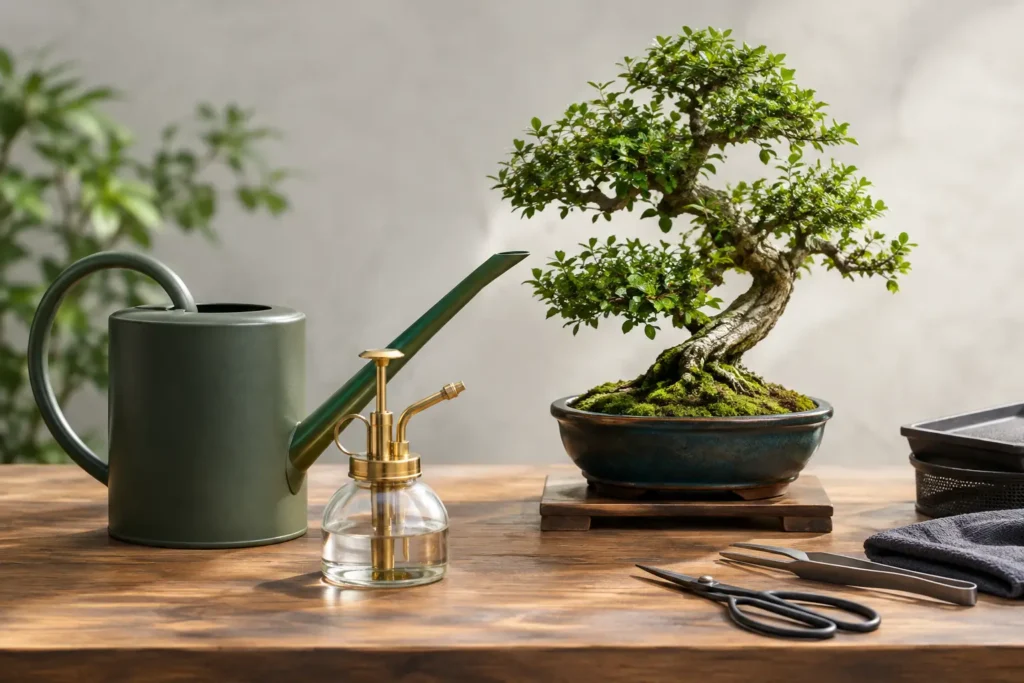
A bonsai can look perfectly healthy at breakfast and noticeably thirsty by dinner on a hot Australian summer day. That is why the right bonsai watering equipment is less about buying fancy gear and more about making it easy to water properly, often enough, without blasting soil out of the pot.
For most beginners, one good watering can and a habit of checking the soil will do more for a tree than a shelf full of gadgets. The useful extras depend on how many trees you own, where they live and how quickly their pots dry out.
Start with the one tool that matters most
A watering can with a fine rose is the best first purchase for nearly every bonsai owner. The rose is the perforated fitting on the end of the spout. It breaks the flow into soft, even droplets, so water reaches the soil without digging holes around exposed roots or washing fine particles over the pot rim.
Look for a can that holds around 2 to 5 litres. A smaller can is easier to control and less tiring if you are watering a few trees on a balcony. A larger one saves trips to the tap when you have a growing collection. Metal cans last well and feel nicely balanced, while plastic options are lighter and usually kinder on the budget. Neither material makes your bonsai healthier – use the one you will happily pick up every day.
A long, narrow spout helps you reach the soil beneath branches. This is particularly handy on dense junipers, pines and ficus, where a wide stream can run off the foliage instead of soaking the root ball.
What a good rose should do
Choose a rose that produces a gentle shower rather than a hard spray. Water should fall evenly across the soil surface and drain through the holes at the base of the pot. If the rose is too fine, it may clog with sediment. If the holes are too large, the stream can disturb loose soil.
It is worth buying a replacement rose or choosing a can with a removable one. A quick rinse now and then keeps mineral build-up and tiny bits of compost from blocking the holes.
The soak, check, repeat method
Equipment only works when paired with a sensible routine. The simplest system is soak, check, repeat.
First, water the entire soil surface slowly until water runs from the drainage holes. Wait a minute or two, then water again. This second pass matters because dry or compacted bonsai soil can shed water down the sides of the pot, leaving the centre surprisingly dry.
Next, check the moisture before reaching for the can again. Push a finger about a centimetre into the soil, or use a wooden chopstick. If it comes out cool and damp with soil clinging to it, the tree can wait. If it is mostly dry, water thoroughly.
Finally, repeat according to what the tree and weather tell you, not a calendar. A small elm in full sun may need water daily in summer. A ficus indoors during a cool spell may need far less. Bonsai is not a “water every Sunday” hobby, unfortunately. The tree did not read the roster.
Is a moisture meter worth buying?
A basic moisture meter can be useful when you are learning, especially with an indoor bonsai or a tree planted in a deep pot. It gives you another clue about what is happening lower in the root zone, where your fingertip cannot reach.
But treat it as a helper, not a referee. Cheap meters can give inconsistent readings, particularly in gritty bonsai mixes, and their metal probes can be awkward around roots. Check the soil surface, lift the pot to learn its weight and observe the tree over time. Those habits become more reliable than any dial.
If you do buy one, choose a simple moisture-only meter. Light and pH readings on inexpensive multi-meters are rarely useful enough to guide bonsai care. Insert the probe gently near the edge of the pot rather than forcing it through thick roots, and wipe it clean after use.
When a hose attachment makes sense
Once you own several outdoor bonsai, a hose with a watering wand can make daily care much quicker. This is especially helpful during dry, windy weather, when a collection can need a proper soak before work and another check later in the day.
Choose a wand with adjustable flow and a soft shower setting. A trigger handle lets you stop and start without walking back to the tap, while a long wand reduces bending when trees are on benches. Avoid using a high-pressure jet setting on bonsai soil. It is useful for cleaning paving, not for watering a shallow pot full of carefully placed roots.
A hose system has a trade-off: convenience can encourage rushed watering. Stand with each tree long enough for the water to penetrate, then return for a second pass if the mix is dry. If your tap water comes out very hot after sitting in a sun-baked hose, let it run onto the garden first. Warm water is not ideal for tender roots.
Bonsai watering equipment that is useful, but not urgent
After your watering can, these items can make care easier. They are not compulsory for a healthy first bonsai.
- A small spray bottle is useful for dampening moss, cleaning dusty leaves or increasing local humidity around a tropical tree briefly. It does not replace watering the roots.
- A shallow watering tray catches drips under indoor trees and protects furniture. Empty it after watering so the pot is not sitting in water.
- A timer is handy for a hose setup or when you are caring for many trees. Use it as a reminder to check, not as an automatic promise that every pot needs the same amount.
- A fine mesh screen or drain cover helps keep soil in place after repotting. It is not watering gear exactly, but it prevents drainage holes from becoming a muddy mess.
Humidity trays deserve a quick reality check. A tray of pebbles and water may create a small pocket of humidity directly around an indoor tree, but it will not fix dry soil, poor light or an air-conditioned room. Keep the base of the pot above the waterline.
Match the gear to where your bonsai lives
For a single bonsai on a kitchen bench or bright indoor spot, a 2-litre watering can with a fine rose, a drip tray and a chopstick are enough. You can add a moisture meter if you are unsure, but start by learning the feel of the soil.
For a sunny balcony, select a can that is easy to refill and carry. Balconies often dry plants faster because reflected heat and wind pull moisture from shallow pots. Check trees more than once on very hot days, particularly if they are in small ceramic pots.
For a backyard bench with several bonsai, a hose wand becomes a practical upgrade. A portable watering can still earns its place for newly repotted trees, small seedlings and any pot that needs a slow, careful soak.
Australian conditions can change quickly between regions and seasons. A tree in humid Brisbane, dry inland Victoria or a breezy Perth courtyard will not dry at the same rate. Species matters too. Native bonsai, tropical ficus, Japanese maples and conifers all have different tolerances, so watch the pot rather than copying another grower’s schedule.
Avoid these common buying mistakes
The biggest mistake is choosing equipment that makes watering look easy but does not wet the root ball. Decorative miniature cans often hold too little water and have poor control. They are charming on a shelf, less charming when you need four refills to water one thirsty tree.
Another common error is relying on a misting bottle. Leaves may look fresh after a mist, but bonsai drink through their roots. Misting can be pleasant for some tropical species in dry conditions, yet it is not a substitute for a deep watering.
Also skip automatic drippers until you understand your tree’s needs. Drip systems can work for a larger collection or holidays, but a blocked emitter or an overly wet pot can create problems quietly. Test any automated setup for several weeks while you are home and still checking each tree.
Buy the best basic can you can comfortably afford, learn how your soil dries, and add equipment only when it solves a real problem. A calm daily check with a gentle watering can is not glamorous, but your bonsai will notice.